How to Select the Right Activation Temperature and Size for Disposable Pop-Up Indicators
How to Select the Right Activation Temperature and Size for Disposable Pop-Up Indicators
Selecting the correct disposable pop-up indicator is an important decision for food manufacturers, poultry processors, and meat production companies. Two of the most important specifications buyers need to consider are activation temperature and product size.
Different food products, cooking processes, and production requirements may require different temperature settings and indicator dimensions. Choosing the right combination helps ensure reliable temperature indication and consistent production results.
This guide explains how professional buyers select the appropriate activation temperature and size for disposable pop-up indicators.
Why Activation Temperature Matters
Activation temperature is the temperature point at which a disposable pop-up indicator changes from its original position to the activated position, providing a visible indication that the target temperature has been reached.
For food manufacturers, selecting the correct activation temperature helps match the indicator with the specific cooking process and product requirements.
Important factors include:
- Food product type
- Cooking method
- Product size
- Customer requirements
- Production standards
Common Activation Temperatures for Food Applications
Professional disposable pop-up indicators are available in different temperature ranges to support various food applications.
| Activation Temperature | Typical Application |
| 125°F | Special temperature indication applications |
| 138°F | Customized food applications |
| 145°F | Medium-temperature cooking applications |
| 160°F | Selected meat and food processing applications |
| 165°F | Poultry and chicken applications |
| 180°F | Meat and higher-temperature cooking applications |
| 185°F | High-temperature cooking requirements |
The correct activation temperature depends on the manufacturer's process requirements and the final food application.
Why 165°F Is a Common Poultry Indicator Temperature
Among poultry applications, 165°F is one of the most commonly requested activation temperatures.
It is frequently used for:
- Chicken products
- Turkey applications
- Poultry processing
- Ready-to-cook poultry products
For poultry manufacturers, a reliable 165°F disposable indicator can help provide a clear visual temperature confirmation during production.
Why Meat Applications May Require Higher Temperatures
Different meat products and cooking processes may require different temperature solutions.
Higher activation temperatures such as 180°F or 185°F may be selected for applications requiring higher cooking temperature indication.
These solutions are commonly considered for:
- Large meat products
- Commercial roasting applications
- Specialized food processing
- High-temperature cooking processes
Understanding Small and Large Disposable Pop-Up Indicator Sizes
Besides activation temperature, physical size is another important specification.
Disposable pop-up indicators are commonly available in different lengths to match different food products.
Small indicators are generally suitable for:
- Standard poultry products
- Smaller food portions
- General cooking applications
Large indicators are generally suitable for:
- Whole turkey products
- Larger poultry items
- Large meat products
- Industrial food applications
How Food Manufacturers Choose the Right Size
The correct size depends mainly on product thickness and application requirements.
Professional buyers usually consider:
- Product dimensions
- Insertion depth requirements
- Cooking environment
- Production method
- Packaging requirements
Choosing the correct size helps ensure that the temperature indicator works effectively within the product.
Matching Indicator Specifications With Production Needs
For industrial customers, the best disposable pop-up indicator is not always the same product for every application.
A professional supplier should help customers evaluate:
- Temperature requirements
- Product size
- Color identification
- Packaging format
- OEM requirements
This application-based approach allows companies to select a solution that fits their production process.
OEM Options for Temperature and Size Requirements
Different customers may require customized specifications for their markets.
OEM solutions may include:
- Custom activation temperatures
- Custom sizes
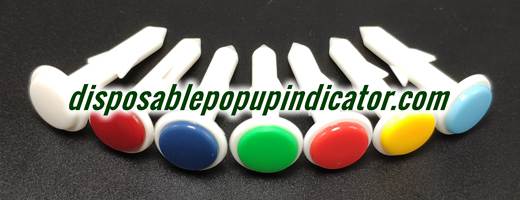
- Custom button colors
- Logo injection
- Private label packaging
Customization allows distributors and food manufacturers to develop products that better match their own requirements.
Frequently Asked Questions
What activation temperature is commonly used for poultry?
165°F is one of the most commonly requested temperatures for poultry applications.
Can disposable pop-up indicators have different temperatures?
Yes. Professional manufacturers can provide different activation temperature options.
What is the difference between small and large indicators?
The main difference is physical size, which affects suitability for different food products.
Which size is suitable for turkey products?
Large-size indicators are often considered for whole turkey and larger poultry applications.
Can buyers request custom temperature settings?
Yes. OEM customers can request customized activation temperatures.
Why is product size important?
The correct size helps ensure proper placement and reliable temperature indication.
Can colors be customized for different temperatures?
Yes. Custom button head colors can be used for product identification.
Are disposable indicators suitable for bulk production?
Yes. They are commonly supplied for large-scale food manufacturing applications.
DISCLAIMER
"Pop-Up Timer" and "Disposable Pop-Up Indicator" are generic industry terms used to describe single-use temperature indication products. We are an independent direct-source manufacturer from China specializing in disposable pop-up indicators and food temperature indication solutions. We are not affiliated with any other brands or companies. Any references are provided only for general industry identification and comparison purposes.